
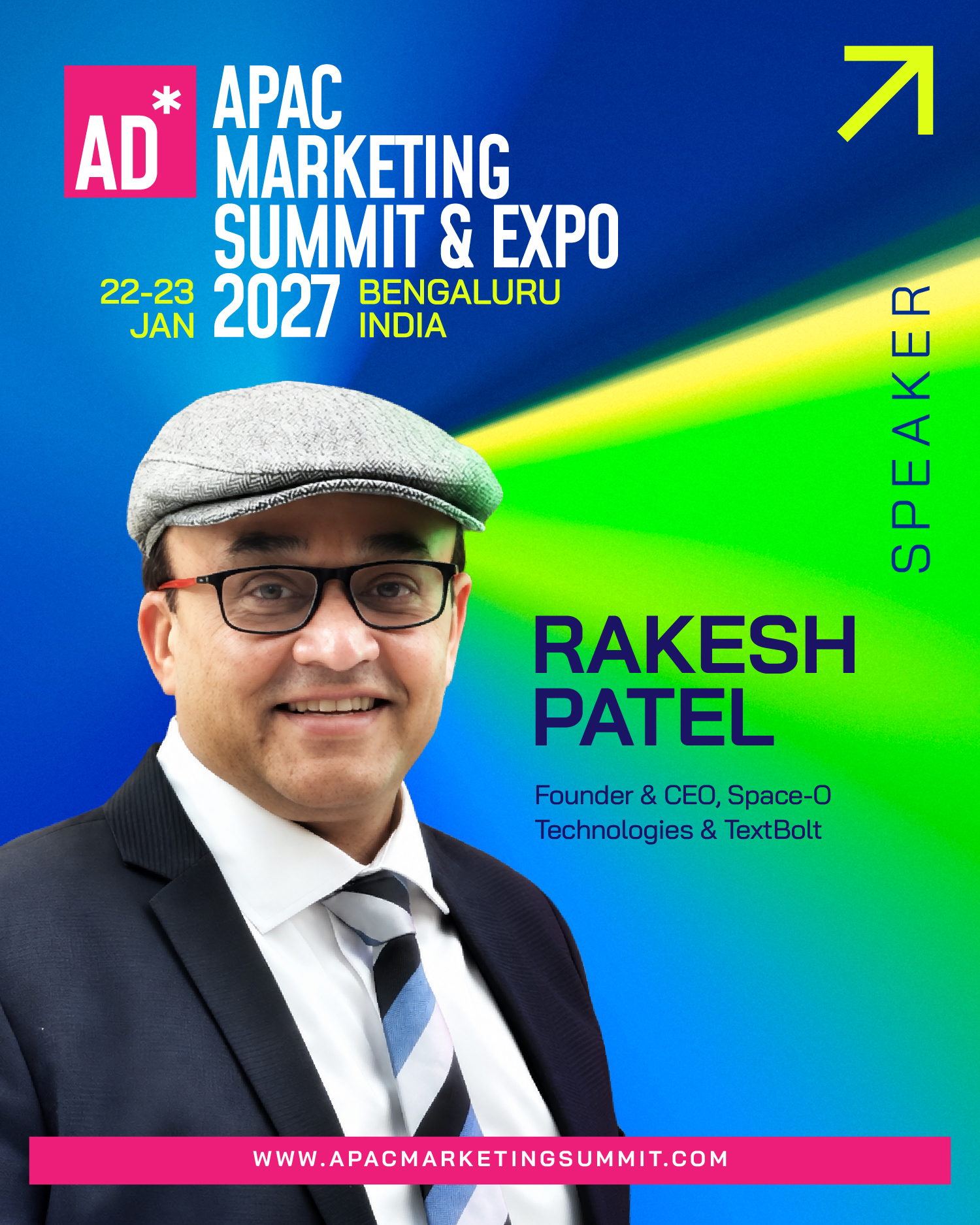
Rakesh Patel
Founder & CEO, Space-O Technologies & TextBolt
Builder of 30+ Micro SaaS Products
Rakesh Patel has stopped prompting his AI agents. He builds graphs and loops instead, and his marketing agents build themselves from there.
Short bio
A founder and growth marketer with 13 successful exits, Rakesh founded Space-O Technologies and TextBolt and has built more than 30 micro SaaS products, each designed to solve one core problem. He markets them almost entirely without paid ads. Self-organizing AI agent systems handle research, content, publishing, distribution and link building with no one in the loop, and the products are winning business from companies such as 3M, FedEx and GE Aerospace. His ambitious goal: a Space-O portfolio of 500+ micro SaaS products.
- APAC Marketing Summit & Expo 2027
- 22–23 January 2027
- AI & MarTech
- Bengaluru, India
- Toronto, Canada
Stop Prompting.
Start Building Marketing That Runs Itself.
How graph-engineered AI agents run content, SEO, distribution and link building for 30+ micro SaaS products
AI has made content almost free, and that has made marketing harder, not easier. Feeds are flooded with look-alike posts. Customers ask ChatGPT and Perplexity instead of searching Google. Every week brings a new tool, and most marketing teams use AI the same way: one prompt, one task, one copy-paste at a time. It feels productive, but it isn't a strategy.
Rakesh Patel took a different path. He stopped prompting his agents. He builds graphs and loops instead, and the agents build themselves from there. That system now runs the marketing for 30+ micro SaaS products, from content creation and publishing to distribution and link building, with no one in the loop. He believes that within 4–6 months, this will be how every serious AI system is built.
This is not a session on AI tools or prompts. It is about the marketing engine behind them, and where the marketing advantage now lives.
You will walk away knowing
Where the marketing advantage has moved
When anyone can produce content, the edge shifts to getting found and getting distributed: on Google, inside AI answers such as ChatGPT, Perplexity and AI Overviews, and across the channels your buyers use.
From prompts to a marketing graph
How research, writing, review, publishing and distribution agents hand off work and check each other, with loops that protect brand voice and quality.
Inside a self-running marketing engine
A live look at the production system: content that goes from research to a published page, automatic distribution, zero-touch link building, and agents that write their own code when one is missing.
Your first marketing graph
You map one of your own marketing workflows into an agent graph, find where it would make the biggest difference, and leave with a clear first step.
Format
- Part 1: Where marketing is heading, with live demos of the production marketing engine.
- Part 2: Hands-on: map your own marketing workflow into an agent graph, plus open Q&A.
Who should attend
CMOs, brand strategists, performance marketers, and MarTech and AdTech leaders who know AI matters but are unsure what to do about it.
Full bio
Rakesh started building in 2010, just as mobile was taking off. He founded Space-O Technologies and built it into a global company with organic search, not paid ads, as its main marketing engine.
That marketing playbook has saved over $2.4M a year in ad spend, and one of his product sites alone ranks for more than 125,000 keywords on Google in the US. Now based in Toronto, Rakesh has taken on an ambitious challenge: can Space-O build its own portfolio of 500+ micro SaaS products, each designed to solve one specific core problem? More than 30 are already live and winning business from companies such as 3M, FedEx and GE Aerospace.
Marketing 500 products by hand is impossible, so he stopped prompting his agents. Prompt engineering was about telling one model what to do. Rakesh now practices graph engineering: designing the loops, branches and handoffs that let a team of AI marketing agents organize itself around a task, from research and writing to publishing, distribution and link building. When the system needs an agent that doesn't exist, it writes the code and builds one. His prediction: within 4–6 months, graph engineering will be the default architecture for anyone building serious agentic systems.
Rakesh has also invested in SaaS and mobile-first startups and written two books on enterprise mobility and Open311. He has run workshops at SEO Estonia and SaaSBOOMi, where his session was the highest-rated at SaaSBOOMi Annual, and he has mentored more than 50 founders.